
Early 1970s to the present
Habal-Habal in Mahaplag
By Marinel R. Caparos
From private motorcycles to public service, riverbank routes, vehicle extensions, and the evolution of the payag.
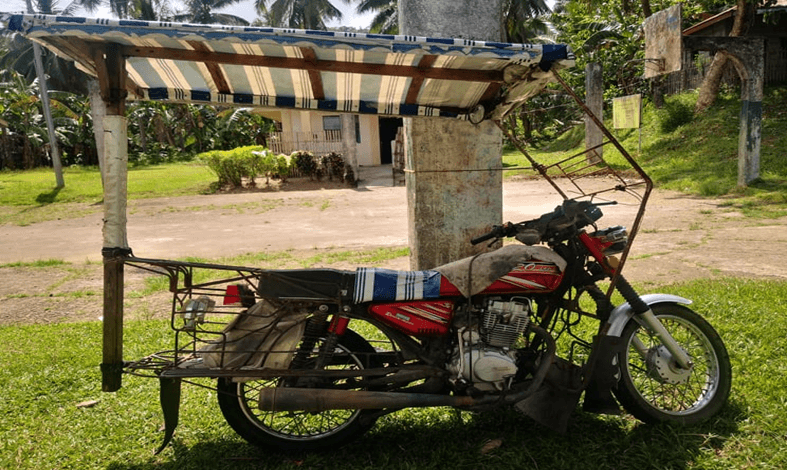
The history of transportation in Mahaplag cannot be understood apart from its physical environment. Characterized by rugged terrain, riverine networks, and a climate marked by frequent rainfall, the municipality historically faced significant constraints in mobility and access. Prior to the development of formal road infrastructure, movement within and beyond Mahaplag depended largely on footpaths and improvised trails, often tracing riverbanks and former logging routes.
Within this environmental and infrastructural context, the emergence of habal-habal—a motorcycle-for-hire—represents a decisive moment in the adaptive strategies of Mahaplaganons to their landscape. More than a mode of transport, it became a practical response to geographic isolation and a crucial vehicle of socio-economic connectivity. As Randy David observes in his discussion of motorcycle-based transport and the “sharing economy” in the Philippines, such informal mobility systems occupy a contested yet indispensable space within contemporary transport debates.¹
Etymology of Habal-Habal
The term habal derives from Cebuano-Binisaya, where it connotes “mating,” as in animal copulation. In local usage, it evolved into a colloquial term referring to a motorcycle “for hire.”² The reduplication of the term—habal-habal—literally suggests “resembling mating,” an allusion to the close bodily proximity of multiple passengers seated behind the driver.
In Mahaplag, Leyte, this transport form has been further modified through the addition of a backward metal extension designed to accommodate more than three passengers, often covered with a payag (makeshift roof). As recalled by Fructuoso B. Ayoc, these adaptations enabled the vehicle to function in difficult terrain while maximizing passenger capacity.³ These vehicles traverse rough and remote areas, linking otherwise isolated communities to essential services such as the transport of agricultural products, access to healthcare, schooling, and employment opportunities.
In Davao City, the history of habal-habal may be traced to the evolution of “trisikads” or pedicabs—initially bicycles with sidecars—which later developed into motorized tricycles in the late 1950s. As shown by Marie Danielle V. Guillen and Haruo Ishida, policy efforts to eliminate “tricyboats” contributed to the emergence of habal-habal, particularly in areas characterized by rough, unpaved roads and underdeveloped transport infrastructure.⁴ The configuration of habal-habal in Toril, Davao City, closely resembles that of Mahaplag, albeit typically without the payag extension.
From Private Motorcycles to Public Service
The origins of habal-habal in Mahaplag may be traced to the early 1970s. Oral testimony from Rodulfo G. Salgo, one of the earliest drivers, recalls a time when motorcycles were rare and owned only by a few individuals, notably Cesar Bartolini and Lolong Trasmonte.⁵ Initially used for private mobility, these motorcycles gradually assumed a public function as residents sought faster alternatives to walking.
The transformation from private use to public service was driven by necessity. As demand for transport grew, motorcycle owners began offering rides for a fee, marking the emergence of what would later be recognized as habal-habal transport. By the mid-1970s, only a small number of operators—fewer than ten—served the municipality.⁵
Demand far exceeded supply. Drivers were often overwhelmed by passengers and, at times, deliberately avoided midday trips to secure rest. The willingness of passengers to negotiate higher fares reflects both the urgency of mobility needs and the difficulty of travel conditions.⁵ Beyond transporting individuals, these early units were also used to carry agricultural produce such as copra and abaca.
Routes of Necessity
In the absence of developed highways, early habal-habal routes followed the logic of terrain rather than formal planning. Drivers navigated along riverbanks, frequently crossing streams and rivers, and often relied on trails established by logging operations. As Salgo recalls, these routes were shaped less by design than by necessity.⁵
The primary routes connected Mahaplag to nearby economic centers such as Baybay and Abuyog, while longer journeys occasionally extended to Tacloban and Ormoc. Despite its relative proximity, Sogod was less frequently served due to steep and hazardous road conditions.⁵
Mobility patterns closely mirrored economic activity. Traders and sari-sari store owners traveled to Baybay to procure goods, while fish vendors sourced supplies from Abuyog for resale in Mahaplag. Journeys to Sogod were typically associated with the acquisition of dried fish, ginamos, and other marine products.⁵
Economics of Early Transport
The early economics of habal-habal reveal both accessibility and constraint. Fares were modest, reflecting limited purchasing power, while fuel costs remained relatively low. However, poor road conditions restricted motorcycles to carrying only one or two passengers at a time.⁵
As conditions gradually improved, operators modified their vehicles to increase capacity. Wooden extensions were added to accommodate additional passengers, signaling early forms of technological adaptation and local entrepreneurship.⁵
The Evolution of the “Payag”
The payag, a protective covering attached to habal-habal units, emerged from the municipality’s climatic conditions.³ Around 1973, a driver known as Doming experimented with enclosing his motorcycle using plastic sheeting supported by wooden frames. The design proved hazardous and was later abandoned.⁵
In 1979, a driver from Brgy. Hilusig introduced a semi-open structure that balanced coverage with stability. By the early 1980s, iron framing improved durability and safety, leading to the modern form of the habal-habal.⁵
Local Knowledge and External Fascination
Local accounts assert that the habal-habal system in Mahaplag developed independently as a response to local needs rather than imitation.³ Anecdotal accounts also describe foreign visitors expressing fascination with the payag, likening it to a “built-in house,” highlighting its uniqueness as vernacular innovation.⁵
While the practice developed locally, the term “habal-habal” was adopted later. Early operators referred to the service as “single service.” The term is believed to have originated in mining areas of Davao City, where motorcycles were used in similarly rough terrain.⁴ Its adoption in Mahaplag in the late 1980s reflects linguistic diffusion and interregional exchange.
Transport as Cultural Heritage
The history of habal-habal in Mahaplag reveals a pattern of adaptation shaped by necessity, environment, and ingenuity. Emerging from the constraints of geography and limited infrastructure, it evolved into a vital system of mobility that supported economic exchange and social interaction.
More than a utilitarian solution, habal-habal has become an enduring cultural marker. Its continued use, even in the presence of improved roads and alternative transport systems, speaks to its resilience and symbolic value. As both a technological response and a cultural artifact, habal-habal occupies a distinctive place in the historical narrative of Mahaplag—an enduring testament to the resourcefulness of its people.
Notes and sources
-
Randy David, “Angkas and the Business of Sharing,” Philippine Daily Inquirer, December 16, 2018, https://opinion.inquirer.net/118208/angkas-and-the-business-of-sharing
-
R. B. De Guzman, C. M. Campo, and J. Ignacio, “Road Warriors: The Challenges of Indigenous Habal-Habal Drivers in Oriental Mindoro, Philippines,” Journal of Management and Development Research 1, no. 1 (2024): 21–27.
-
Fructuoso B. Ayoc, personal communication, July 4, 2021.
-
Marie Danielle V. Guillen and Haruo Ishida, “Motorcycle-Propelled Public Transport and Local Policy Development: The Case of ‘Tricycles’ and ‘Habal-Habal’ in Davao City, Philippines,” IATSS Research 28, no. 1 (2004): 56–66.
-
Rodulfo G. Salgo, personal communication, May 29, 2021.